
Program Title: Designing, Managing and Debugging Quantum Networks (QUESTING)
Funding: Horizon Europe Marie Skłodowska-Curie Doctoral Networks
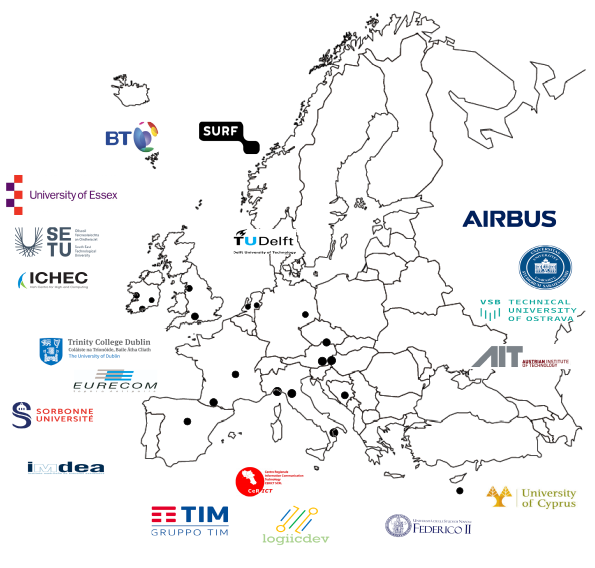
Consortium: 9 leading universities and 10 industry partners across Europe
About The Project
QUESTING will be the ground of 15 doctoral candidates who will turn out to be “Q-System Innovators” at the very beginning of quantum technology. The main objectives of the project are:
- Scientific Innovation: The aim is to make revolutionary changes through research in the area of quantum and hybrid classical-quantum networks regarding their design, management, and debugging of distributed.
- Well-Planned Interdisciplinary Training: To sustainably train Ph.D. students in the fields of quantum physics, computer science, and communications engineering.
- Impact Across Sectors: To connect academic research with industry’s application, thus making research outcomes useful and commercially viable. The candidates for the doctorate will be at one of the 9 beneficiary universities and will receive joint supervision, intersectoral secondments, a comprehensive training program in technical and transferable skills, and integration into a lively European research network.
All Ph.D. candidates who are accepted into the program will need to do two secondments at other consortium partners, one academic and one industrial, as part of their doctoral training.
Requirements
The Doctoral Candidates must be:
- Having a Master’s degree that gives them the right to pursue a doctorate formally.
- Not having received a Ph.D. degree.
- Adherence to MSCA Mobility Rule: Must not have lived or done their main activity (work, studies, etc.) in the country of the recruiting beneficiary for over 12 months in the last 36 months before the recruitment date.
- The ability to collaborate, attend conferences and training events, and take part in academic and non-academic secondments abroad.
For further information on eligibility criteria and on Marie Skłodowska-Curie Actions Doctoral Networks, please visit: https://marie-sklodowska-curie-actions.ec.europa.eu/actions/doctoral-networks
For Who?
If you:
- Hold a Master’s degree in Physics, Computer Science, Electrical/Telecommunications Engineering, Mathematics, or related field.
- Have not completed a PhD during the recruitment process.
- Are adherent to the MSCA mobility rule.
- Are equipped with strong analysis, research, and programming (Python, C++, and MATLAB) skills
- Are willing to participate in challenging interdisciplinary research.
What is Offered?
- A contract lasting 36 or 48 months (depends on host) will be offered with the EU MSCA grant.
- Attractive gross salary that can cover living allowance plus mobility allowance (if applicable).
- Joint supervision from elite academic and industrial partners (intersectoral placements).
- A thorough training plan will be available: technical schools education, transferable skills, Open Science, and career development.
Topics
1. Capacity bounds of realistic co-existing classical-quantum networks (SETU, Ireland)
2. Distributed decision making for complex quantum networks (SETU, Ireland)
3. SDN control planes for quantum systems (TCD, Ireland)
4. Influence of topology in designing & operation of distributed quantum networks (Host: TCD, Ireland)
5. Quantum annealing and quantum-inspired heuristics for wireless optimization problems (UCY, Cyprus)
6. Quantum-assisted machine learning for decision making in wireless communication systems (UCY, Cyprus)
7. Co-design of Network-Aware Quantum compiler for Distributed Quantum computing (UNINA, Italy)
8. Quantum Internet Protocol Stack Design and Use-case Identification (UNINA, Italy)
9. Novel applications of quantum networks beyond QKD (TU Delft, Netherlands)
10. Novel methods for quality improvement of remote entanglement (TU Delft, Netherlands)
11. Improving the efficiency of secret key rate in post-processing of QKD link (VSB, Czechia)
12. Design of QKD encryptors for emerging networking technologies (UNSA, Bosnia & Herzegovina)
13. Analysis and implementation of advanced quantum networking protocols (SU, France)
14. Trade-offs in quantum resources required for distributed architectures (SU, France)
15. Nature-Inspired Optimization Strategies for Quantum Network Routing (UESSEX, United Kingdom)
How To Apply?
Applications must be submitted directly to the respective host institutions. For detailed descriptions of each project, specific application deadlines, and submission guidelines, please refer to the host institutions.